Federal Emergency Relief Administration Lean Beef
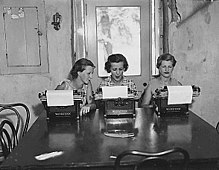 Army camp for unemployed women in Pennsylvania (1934) | |
| Agency overview | |
|---|---|
| Formed | May 12, 1933 |
| Preceding |
|
| Dissolved | December 1935 |
| Superseding agency |
|
| Employees | Provided work for over xx million people |
| Child agency |
|
The Federal Emergency Relief Administration (FERA) was a program established past President Franklin Roosevelt in 1933, edifice on the Hoover administration's Emergency Relief and Construction Act. It was replaced in 1935 by the Works Progress Administration (WPA).
Prior to 1933, the federal regime gave loans to the states to operate relief programs. One of these, the New York land program TERA (Temporary Emergency Relief Administration), was set upwardly in 1931 and headed by Harry Hopkins, a close adviser to Governor Franklin D. Roosevelt. Roosevelt asked Congress to set up FERA—which gave grants to the states for the aforementioned purpose—in May 1933, and appointed Hopkins to head information technology. Forth with the Civilian Conservation Corps (CCC) information technology was the offset relief performance under the New Bargain.
FERA'southward master goal was to alleviate household unemployment by creating new unskilled jobs in local and country authorities. Jobs were more expensive than straight greenbacks payments (called "the dole"), simply were psychologically more beneficial to the unemployed, who wanted any sort of job, for self-esteem. From May 1933 until information technology closed in December 1935, FERA gave states and localities $3.1 billion (the equivalent of $55.4 billion in 2017).[1] FERA provided work for over 20 million people and adult facilities on public lands across the land.
Faced with continued high unemployment and concerns for public welfare during the coming winter of 1933–34, FERA instituted the Civil Works Administration (CWA) every bit a $400 one thousand thousand brusk-term measure to become people to work. The Federal Emergency Relief Administration was shut downwards in 1935 and its work taken over past two completely new federal agencies, the Works Progress Administration and the Social Security Administration.
Projects [edit]

Route construction project in progress in Kirkland, Washington (1934)

Military camp for unemployed women in Atlanta (1934)

Distribution of article of clothing in Seattle (1934)
FERA operated a wide variety of work-relief projects, including construction, projects for professionals (eastward.1000., writers, artists, actors, and musicians), and production of consumer goods.[2] [3]
Vocational teaching [edit]
Workers' education, a form of adult pedagogy, emphasized the study of economical and social problems from the workers' perspective. When the FERA created its adult instruction plan in 1933, workers' didactics classes were included. Between 1933 and 1943, 36 experiment programs in workers' education were launched, 17 of them lasting over x years. With as many equally 2 one thousand teachers employed at one time, officials conservatively estimated that the plan reached at least i meg workers nationwide until it was concluded in World State of war 2. Three distinct phases of a federal workers' education program existed: FERA (1933–1935), Works Progress Assistants (WPA—prior to separation from the other adult education programs, 1935–1939), and WPA Workers' Service Plan (1939–1943). FERA and WPA workers' educational activity stimulated educational activities within the labor movement. For example, in Indiana this program was peculiarly popular amidst the new, more than radical CIO unions. Federal workers' didactics activities as well encouraged union-university cooperation and laid the foundation for labor education at Indiana Academy. New Dealers designed the WPA Workers' Service Program as the model for a Federal Labor Extension Service, similar to the existing federal agricultural extension program, but it was never implemented.[iv]
Women [edit]

Ellen Sullivan Woodward was director of women'due south work for FERA and CWA. During the short lifespan of the CWA, Woodward placed women in such ceremonious works projects equally sanitation surveys, highway and park adornment, public building renovation, public records surveys, and museum development. Virtually were unemployed white neckband clerical workers. In July 1934, the FERA established a separate sectionalisation for professional and nonconstruction projects. Project designers in the division for professional projects faced an enormous challenge in creating effective and meaningful work for unskilled women. In 1935 she became assistant ambassador of the Works Progress Administration, where she directed the income-earning projects of some 500,000 women.[5]
Food [edit]
Poor people lacked enough food in the Depression, and farmers had too much. The mismatch was solved past the Federal Surplus Relief Corporation (FSRC), FERA, and WPA programs which aimed to reduce farm surpluses by government purchase and then redistribution of food to the needy. 3 methods of distribution were employed with varying success: directly distribution, food stamps, and school lunches.[6]
Land and local studies [edit]
Oklahoma [edit]
Mullins (1999) examines the hesitant relief efforts of Oklahoma City residents during the early years of the Depression, 1930–35, under Governor William H. Murray, emphasizing the community's reluctance to comply with FERA rules. Fearing that aid recipients would become dependent on their assistance, Oklahoma City administrators sparingly doled out federal and local relief funds; city leaders initiated a campaign to discourage migration into the metropolis; local newspapers failed to impress the location of soup lines; voters rejected a bond issue to bolster relief funds; and the city quango declined to increase taxes to boost its depression relief budget. At result was the command over FERA distribution imposed by Governor Murray, and lawmakers' reluctance to come across federal funding match assessments, despite a budget surplus in Oklahoma City and sufficient state funds to reduce property taxes. Although he criticized the welfare bureaucracy, Murray championed the land's yeoman farmers and took credit for the food, seed, and books that they received from federal funds. New Deal administrators ultimately removed Murray from his oversight role, charging corruption in assist distribution, failure to encounter employment quotas, and the inability to make up one's mind local funding needs.[7]
Nebraska [edit]
In Nebraska, Autonomous Governor Charles Due west. Bryan (blood brother of William Jennings Bryan and the party's Vice President nominee in 1924) was at first unwilling to request aid from the Hoover administration. When Roosevelt'due south FERA became law in 1933 Nebraska took part. Rowland Haynes, the land'southward emergency relief director, was the major strength in implementing such national programs as the FERA and CWA. Robert L. Cochran, who became governor in 1935, was a "cautious progressive" who sought federal help and placed Nebraska amid the first American states to adopt a social security law. The enduring impact of FERA and social security in Nebraska was to shift responsibleness for social welfare from counties to the state, which henceforth accepted federal funding and guidelines. The change in state and national relations may have been the about important legacy of these New Deal programs in Nebraska.[8]
Tenant farmers [edit]
FERA made welfare payments to Southern tenant farmers 1933-35, with the distribution of coin across states and counties was strongly influenced by country governments and the influential planter form. Their interests rested mainly in non allowing federal welfare to undermine their authorisation and the economic structure that favored landowners. Tenant farmers, nonetheless, exerted significant counterpressure by organizing the Southern Tenant Farmers Union and the Alabama Sharecroppers' Wedlock nether the auspices of the Socialist Party and the Communist Party. The unions agitated for welfare assistance, and their events and campaigns drew national publicity. While tenant farmers remained terribly disadvantaged politically, their collective efforts improved matters essentially in areas where their organizations were strongest.[9]
Fundamental Due west [edit]
Julius Stone Jr., changed the economic direction of Key West, Florida, when he was the director of the southeast region of FERA. In 1934, Key West went bankrupt and land turned the city over to the FERA in a dubious ramble move. Within two years, Rock had reversed the economical disaster and successfully moved the city into tourism. Inventor and educator Blake R. Van Leer likewise assisted with these efforts and consulted for the state of Florida.[10] [11]
See also [edit]
- Social Security (United states of america)
- Darwin William Tate, Los Angeles City Council member, 1933–39, critical of FERA
- California State Relief Administration
References [edit]
- ^ Trowbridge, D.J. (2016). A History of the The states: 1865 to present. Asheville, NC: Soomo Learning. http://www.webtexts.com/courses/19333-schaller/traditional_book/chapters/1696149-the-new-bargain-and-origins-of-world-war-ii-19321939/pages/1428876-the-offset-hundred-days?q=FERA
- ^ Rose, Nancy Due east. (1988). "Product-for-Use or Production-for-Profit?: The Contradictions of Consumer Goods Production in 1930s Piece of work Relief". Review of Radical Political Economics. xx: 46–61. doi:10.1177/048661348802000103. S2CID 154272154.
- ^ Rose, Nancy E. (1988). "Product-for-use or Product-for-turn a profit?: the Contradictions of Consumer Goods Production in 1930s Work Relief". Review of Radical Political Economic science. 20 (one): 46–61. doi:x.1177/048661348802000103. ISSN 0486-6134. S2CID 154272154.
- ^ Hamilton, Donald Eugene (1984). A History of FERA and WPA Workers' Education: The Indiana Experience 1933-1943. PhD dissertation Brawl State U. . DAI 1984 45(iii): 919-920-A. DA8412604 Fulltext: ProQuest Dissertations & Theses
- ^ Young man, Martha H. (1983). "'The Forgotten Adult female': Ellen S. Woodward an Women's Relief in the New Deal". Prologue. 15 (4): 201–213. ISSN 0033-1031.
- ^ Hicks, Floyd W.; Lambert, C. Roger (1978). "Food for the Hungry: Federal Nutrient Programs in Arkansas, 1933-42". Arkansas Historical Quarterly. 37 (ane): 23–43. doi:10.2307/40023163. ISSN 0004-1823. JSTOR 40023163.
- ^ William H. Mullins, "In the midst of Arduousness: the Metropolis, the Governor, and the FERA," Chronicles of Oklahoma (1999) 76(4): 374-391 and 77(ane): 54-73. ISSN 0009-6024
- ^ Grimes, Mary Cochran (1990). "From Emergency Relief to Social Security in Nebraska". Nebraska History. 71 (3): 126–141. ISSN 0028-1859.
- ^ Southworth, Caleb (2002). "Assistance to Sharecroppers: How Agrarian Class Structure and Tenant-farmer Politics Influenced Federal Relief in the South, 1933-1935". Social Science History. 26 (1): 33–70. doi:10.1215/01455532-26-1-33. ISSN 0145-5532. S2CID 246274833. Archived from the original on 2016-03-04.
- ^ Boulard, Garry (1988). "'Land of Emergency': Key Westward in the Groovy Depression" (PDF). Florida Historical Quarterly. 67 (two): 166–183. ISSN 0015-4113. Archived (PDF) from the original on 2008-12-04.
- ^ "The Fundamental W citizen. [book] (Key West, Fla.) 1879-current, September ten, 1934, Epitome 1". ten September 1934.
Further reading [edit]
- Bremer William Westward. "Along the American Way: The New Bargain's Piece of work Relief Programs for the Unemployed." Journal of American History 62 (Dec 1975): 636-652. online at JSTOR
- Brock William R. Welfare, Republic and the New Deal (1988), a British view
- Charles, Searle F. Minister of Relief: Harry Hopkins and the Depression (1963)
- Hopkins, June. "The road not taken: Harry Hopkins and New Bargain Work Relief." Presidential Studies Quarterly 29, 2(306-316). online edition
- Howard, Donald S. The WPA and Federal Relief Policy (1943) full text online
- Meriam; Lewis. Relief and Social Security The Brookings Establishment. (1946). Highly detailed analysis and statistical summary of all New Bargain relief programs; 900 pages online edition
- Whiting, Theodore E.; Woofter, Thomas J. (1941). "Summary of Relief and Federal Piece of work Program Statistics, 1933-1940". Internet Archive. Washington, D.C.: U.Southward. Authorities Printing Office.
- Roosevelt, Franklin D. (1942). "Security, Piece of work, and Relief Policies". Cyberspace Archive. Washington, D.C.: U.S. Government Printing Office.
- Mertz, Paul. New Deal Policy and Southern Rural Poverty. (1978)
- Sautter, Udo. "Government and Unemployment: The Use of Public Works earlier the New Bargain," The Journal of American History, Vol. 73, No. 1 (Jun., 1986), pp. 59–86 in JSTOR
- Sautter, Udo. Iii Cheers for the Unemployed: Government and Unemployment before the New Deal (1992) excerpt and text search
- Singleton, Jeff. The American Dole: Unemployment Relief and the Welfare Country in the Slap-up Low (2000) online edition; also excerpt and text search
- Sternsher, Bernard (1964). Rexford Tugwell and the New Deal. Brunswick, New Jersey: Rutgers University Press. OCLC 466310. online edition
- Venkataramani, M. S. "Norman Thomas, Arkansas sharecroppers, and the Roosevelt agronomical policies, 1933–1937." Mississippi Valley Historical Review (1960) 47: 225–46. in JSTOR
- Williams; Edward Ainsworth Federal Assistance for Relief (1939) online edition
- Chief sources
- Hopkins, Harry L. Spending to save: the complete story of relief. Seattle: University of Washington Press, 1936.
- Kirk, J.S. ed.Emergency Relief in North Carolina a Record of the Evolution and the Activities of the North Carolina Emergency Relief Administration 1932-1935 (1936) 544pp; consummate text online
- McElvaine, Robert S. Down & out in the Bang-up Depression: Letters from the "Forgotten Man" (1983); messages to Harry Hopkins; online edition
External links [edit]
- FERA Program description
- Academy of Washington Libraries Digital Collections – Federal Emergency Relief Administration Photographs Essay on the program and images documenting the Federal Emergency Relief Administration program in King County, Washington, 1933-35.
- ERA and FERA in Utah
- Complete List of New Deal Communities, of the Federal Emergency Relief Administration, the Resettlement Administration, and the Division of Subsistence Homesteads, from the National New Deal Preservation Association
pattersonsquirequisen.blogspot.com
Source: https://en.wikipedia.org/wiki/Federal_Emergency_Relief_Administration
0 Response to "Federal Emergency Relief Administration Lean Beef"
Post a Comment